











You’ve found a supplier, negotiated the price, and confirmed the product details. Now comes the most important question:
How do you pay Chinese suppliers safely?
Many importers worry about sending money overseas. What if the supplier disappears after receiving the payment? What if the bank account details are fake? What if the goods never arrive?
The good news is that there are several reliable China payment methods available today. From T/T bank transfers and Letters of Credit to PayPal and payment agent services, each option offers different levels of security, cost, and flexibility.
In this complete China payment guide, you’ll learn the most common ways of paying Chinese suppliers, how to choose the right method for your business, and how to reduce payment risks when you send money to China. We’ll also cover common scams, payment terms, currency choices, and practical tips to help you make safer international transactions.
Kluczowe wnioski
- T/T bank transfer remains the most common way to pay Chinese suppliers, but it offers limited buyer protection and should be used with verified suppliers.
- Different China payment methods serve different needs. Options such as Letters of Credit, PayPal, Trade Assurance, and payment agents each have their own advantages and risks.
- Before sending money to China, always verify the supplier’s business information, bank account details, and payment terms.
- First-time importers should prioritize secure payment options and avoid paying 100% upfront whenever possible.
- Choosing between RMB and USD payments can affect your total sourcing costs due to exchange rates and bank fees.
- Businesses working with multiple suppliers can reduce costs and simplify operations through consolidated payment solutions or China payment agents.
- Understanding common payment scams and risk-control measures is essential for safely paying Chinese suppliers and protecting your investment.
Why Choosing the Right China Payment Method Matters
Different Payment Methods Offer Different Levels of Protection
For example, a T/T bank transfer is widely accepted and cost-effective, but once the money is sent, it is difficult to reverse the transaction. In contrast, methods such as Letters of Credit or Alibaba Trade Assurance offer additional protection because payments are tied to specific conditions.
Choosing the right option depends on factors such as order value, supplier relationship, and risk tolerance.
Payment Terms Can Impact Cash Flow
Many Chinese suppliers require a deposit before production starts, with the remaining balance paid before shipment.
For larger orders, negotiating favorable payment terms can significantly improve cash flow management and reduce financial pressure.
International Payment Costs Can Add Up Quickly
Depending on the payment method, you may incur:
- Bank transfer fees
- Currency conversion charges
- Intermediary bank fees
- Payment platform service fees
When paying Chinese suppliers regularly, these costs can have a noticeable impact on your overall sourcing budget.
Payment Risks Increase When Working With New Suppliers
Without proper verification, buyers may encounter issues such as:
- Fake supplier accounts
- Unauthorized bank account changes
- Payment fraud
- Suppliers failing to deliver goods as agreed
This is why supplier verification and payment security should always be part of your sourcing process before you send money to China.
The Right Payment Strategy Supports Long-Term Growth
As your business grows, managing payments becomes more complex. You may work with multiple suppliers, purchase from platforms like 1688, or need to handle RMB payments.
Understanding your options from the beginning will help you make safer and smarter payment decisions throughout your importing journey.
Common China Payment Methods Explained
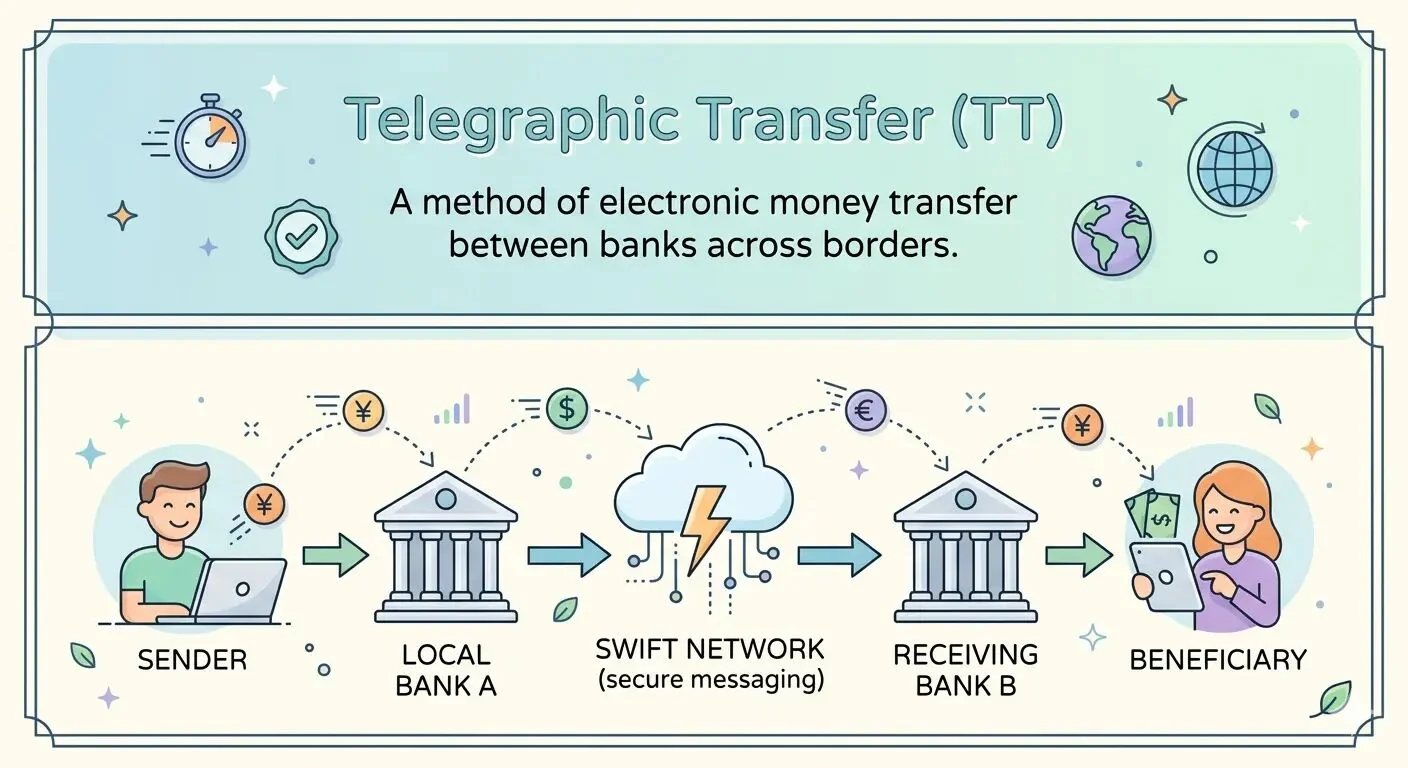
T/T (Telegraphic Transfer)
T/T, also known as a wire transfer, is the most widely used method for paying Chinese suppliers. Funds are sent directly from your bank account to the supplier’s company bank account through the international banking system.
The standard payment structure is:
- 30% deposit before production
- Saldo 70% przed wysyłką
Pros
- Accepted by almost all Chinese suppliers
- Relatively low transaction fees
- Suitable for medium and large orders
Cons
- Limited buyer protection
- Difficult to recover funds once the payment is completed
Najlepsze dla
- Established supplier relationships
- Orders above a few thousand dollars
- Buyers familiar with international trade
L/C (Letter of Credit)
A Letter of Credit (L/C) is a bank-guaranteed payment method commonly used in larger international transactions.
Under this arrangement, the buyer’s bank agrees to release funds only after the supplier provides the required shipping and trade documents. This helps reduce risk for both parties.
Pros
- High level of payment security
- Suitable for large transactions
- Bank involvement adds protection
Cons
- More paperwork and documentation
- Higher banking fees
- Longer processing time
Najlepsze dla
- High-value orders
- First transactions with new suppliers
- Corporate buyers with established banking support
D/P (Documents Against Payment)
D/P (Documents Against Payment) is a trade payment method in which the supplier ships the goods and sends the shipping documents through banks. The buyer can only obtain the documents and claim the goods after making payment.
This method provides more protection for buyers than paying the full amount before shipment because payment is made after the goods have been shipped.
Pros
- Better security than full prepayment
- Supplier ships goods before receiving full payment
- Lower cost than a Letter of Credit
Cons
- Less protection than an L/C
- Banks only handle documents, not product quality
- Suppliers may be reluctant to accept D/P for new buyers
Najlepsze dla
- Medium-value orders
- Buyers and suppliers with some trading history
- Transactions where both parties seek balanced risk
D/A (Documents Against Acceptance)
D/A (Documents Against Acceptance) is similar to D/P, but instead of paying immediately, the buyer accepts a time draft and agrees to pay at a future date, such as 30, 60, or 90 days after shipment.
Once the buyer accepts the draft, the shipping documents are released.
Pros
- Improves buyer cash flow
- Allows payment after goods are shipped
- Useful for long-term business relationships
Cons
- Higher risk for suppliers
- Usually unavailable to new buyers
- Payment disputes may occur if trust is lacking
Najlepsze dla
- Established supplier relationships
- Large importers with strong credit
- Repeat orders
O/A (Open Account)
Open Account (O/A) is one of the most buyer-friendly payment terms in international trade. The supplier ships the goods first, and the buyer pays later according to agreed terms, such as Net 30, Net 60, or Net 90 days.
Under this arrangement, the supplier carries most of the payment risk.
Pros
- Excellent cash flow for buyers
- No upfront payment required
- Simplifies purchasing operations
Cons
- Very high risk for suppliers
- Rarely offered to new customers
- Usually requires a long-term partnership
Najlepsze dla
- Large-volume buyers
- Long-term supplier relationships
- Established import businesses
PayPal
PayPal is often used for samples, trial orders, and smaller transactions. It offers buyer protection and fast payment processing, making it attractive for first-time buyers.
However, many Chinese factories prefer other payment methods because PayPal fees can be relatively high.
Pros
- Fast and easy to use
- Buyer protection features
- Suitable for small transactions
Cons
- Higher transaction fees
- Not accepted by all suppliers
- Less practical for large orders
Najlepsze dla
- Przykładowe zamówienia
- Small purchases
- Initial supplier testing
Alibaba Trade Assurance
Alibaba Trade Assurance is an escrow-style payment service offered through Alibaba. Funds are held within the platform and released according to agreed order terms.
For many first-time buyers, it provides an extra layer of confidence when working with new suppliers.
Pros
- Payment protection
- Dispute resolution support
- Easy to use for Alibaba transactions
Cons
- Available only for eligible Alibaba orders
- Protection scope may vary depending on the case
Najlepsze dla
- First orders
- New supplier relationships
- Small and medium-sized purchases
Wise, Payoneer, and Other International Payment Platforms
Modern payment platforms have become increasingly popular for buyers looking to send money to China while reducing transfer fees and currency conversion costs.
These services can often provide better exchange rates than traditional banks and make cross-border payments more efficient.
Pros
- Competitive exchange rates
- Lower transfer costs
- Faster payment processing
Cons
- Not all suppliers accept every platform
- Transaction limits may apply
Najlepsze dla
- Frequent international payments
- Small and medium-sized transactions
- Cost-conscious importers
China Payment Agent Services
Some overseas buyers use a China payment agent to handle supplier payments on their behalf.
This option is especially useful when purchasing from domestic Chinese platforms such as 1688 or when managing payments to multiple suppliers. A payment agent can help consolidate transactions, process RMB payments, and simplify financial management.
Pros
- Simplifies supplier payments
- Supports RMB settlement
- Useful for multi-supplier sourcing
Cons
- Service fees may apply
- Requires choosing a reliable service provider
Najlepsze dla
- Buyers working with multiple suppliers
- Businesses seeking centralized payment management
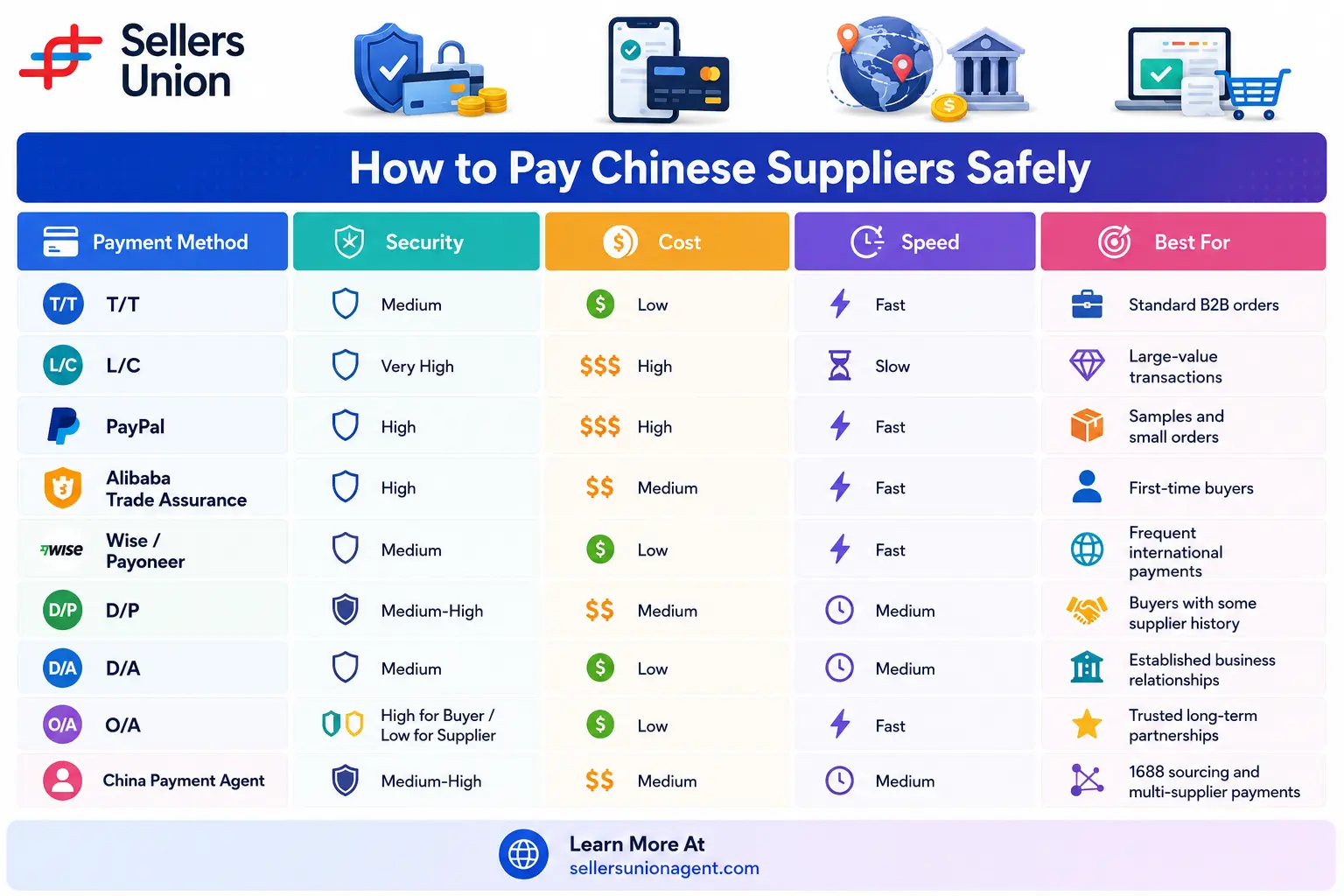
| Payment Method | Security | Koszt | Prędkość | Najlepsze dla |
|---|---|---|---|---|
| T/T | Średni | Niski | Fast | Standard B2B orders |
| L/C | Bardzo wysoka | Wysoki | Slow | Large-value transactions |
| PayPal | Wysoki | Wysoki | Fast | Samples and small orders |
| Alibaba Trade Assurance | Wysoki | Średni | Fast | First-time buyers |
| Wise / Payoneer | Średni | Niski | Fast | Frequent international payments |
| D/P | Medium-High | Średni | Średni | Buyers with some supplier history |
| D/A | Średni | Niski | Średni | Established business relationships |
| O/A | High for Buyer / Low for Supplier | Niski | Fast | Trusted long-term partnerships |
| China Payment Agent | Medium-High | Średni | Średni | 1688 sourcing and multi-supplier payments |
Understanding Standard Payment Terms in China
30% Deposit + 70% Balance
This is the most common payment term in China sourcing. Under this arrangement, the buyer pays a 30% deposit before production begins and the remaining 70% before shipment or after a successful pre-shipment inspection.
Zalety
- Widely accepted by Chinese suppliers
- Balances risk for both parties
- Suitable for most standard orders
Najlepsze dla
- First orders with verified suppliers
- Most B2B sourcing projects
50% Deposit + 50% Balance
Some suppliers request a higher deposit, especially for customized products or orders that require special materials.
Zalety
- May help secure production capacity
- Common for customized products
- Can simplify payment arrangements
Considerations
- Higher upfront financial exposure
- Less leverage before shipment
Najlepsze dla
- Custom-made products
- Low-volume production runs
- Suppliers with an established track record
100% Payment Upfront
Some suppliers may request full payment before production starts.
Najlepsze dla
- Przykładowe zamówienia
- Small-value purchases
- Long-term trusted suppliers
How to Choose the Right Payment Terms
When deciding how to structure a supplier payment China transaction, consider:
- Order value
- Supplier experience
- Product complexity
- Cash flow requirements
- Risk tolerance
For most buyers, especially those placing their first few orders, the standard 30% deposit and 70% balance arrangement remains the most practical option because it balances security, flexibility, and supplier acceptance.
Paying Chinese Suppliers in RMB vs USD
Today, many Chinese suppliers can accept payments in either RMB (Chinese Yuan) or USD (US Dollar). Each option has its own advantages, and the best choice depends on your supplier, payment provider, and business needs.
Paying in RMB
Some suppliers prefer receiving RMB because it allows them to avoid currency conversion after receiving the payment. In return, they may be willing to offer more competitive pricing.
Benefits of Paying in RMB
- Potentially lower product prices
- Reduced currency conversion on the supplier side
- Faster settlement for domestic Chinese transactions
Challenges of Paying in RMB
- Not all international banks support RMB payments
- Additional payment services may be required
- Exchange rates can vary between providers
- Accounting may be more complex for some businesses
Many overseas buyers use sourcing companies or payment agents when making RMB payments to China.
Paying in USD
USD remains the most widely used currency in international trade.
Many Chinese exporters regularly work with overseas buyers and already maintain USD accounts. This makes USD payments simple and familiar for both parties.
Benefits of Paying in USD
- Accepted by most export-oriented suppliers
- Easier international banking support
- Simplified accounting for many importers
- Widely available payment channels
Challenges of Paying in USD
- Suppliers may include exchange-rate costs in their pricing
- Currency fluctuations can affect final costs
- Multiple conversion fees may apply during the transaction process
Although these costs are often small, they can become significant when handling large orders or frequent payments.
Which Currency Saves More Money?
There is no universal answer.
In some cases, paying in RMB can reduce costs because suppliers avoid exchange-related expenses. In other situations, paying in USD may be more economical due to better banking support and lower transfer complexity.
Before you send money to China, consider:
- The supplier’s preferred currency
- Exchange rates offered by your bank or payment provider
- Transfer fees
- Order value
- Accounting requirements
Best Practice for Buyers
When requesting quotations, ask suppliers to provide prices in both RMB and USD whenever possible.
Comparing the two options allows you to:
- Identify hidden conversion costs
- Negotiate better pricing
- Select the most cost-effective payment route
As your sourcing volume grows, reviewing currency options regularly can help improve margins and make your supplier payment China strategy more efficient.
How to Verify Suppliers Before Sending Money
No matter which China payment method you choose, supplier verification should always come before payment.
Check the Company’s Business Information
Key information to verify includes:
- Company registration name
- Business license
- Registered address
- Contact information
- Export qualifications (if applicable)
Make sure the company name on official documents matches the company you have been communicating with.
Confirm the Bank Account Details
Before making a payment, carefully review the bank account information.
Pay attention to:
- Beneficiary name
- Bank account number
- Bank name
- SWIFT code
The beneficiary name should generally match the supplier’s registered company name.
If you receive a last-minute request to change bank account details, do not process the payment immediately. Contact the supplier through a verified communication channel and confirm the change before proceeding.
Verify the Supplier’s Production Capabilities
Ask for:
- Factory photos
- Production videos
- Product certifications
- Quality control information
- Previous export experience
Review Online Presence and Trade History
A supplier with a stable business history usually leaves a digital footprint.
Useful sources of information include:
- Alibaba profiles
- Made-in-China profiles
- Company websites
- Social media accounts
- Customer reviews
Request Product Samples
Samples can help you assess:
- Jakość produktu
- Wydajność komunikacji
- Packaging standards
- Delivery performance
Although samples involve additional cost, they can help prevent much larger losses later.
Consider a Supplier Verification Service
For larger orders, many importers use third-party verification services before making payment.
A supplier verification report may include:
- Business registration checks
- Audyty fabryczne
- Production capability assessments
- Compliance reviews
- On-site inspections
How to Avoid China Payment Scams
Payment scams are one of the biggest concerns for importers.
The good news is that most scams follow common patterns. By recognizing the warning signs early, you can significantly reduce risk when paying Chinese suppliers.
Watch for Sudden Bank Account Changes
One of the most common scams involves fake bank account updates.
A buyer receives an email claiming that the supplier has changed its bank account and requests that future payments be sent to a new account. In some cases, the email may even appear to come from the supplier’s real address due to email hacking.
Before you send money to China, always verify any account change through a separate communication channel, such as a phone call, video meeting, or messaging platform already used with the supplier.
Avoid Paying Personal Bank Accounts
Legitimate suppliers usually request payment to a registered company bank account.
If a supplier asks you to transfer funds to an individual’s personal account, especially for a large order, proceed with caution.
Be Careful With Extremely Low Prices
A price that is far below the market average can be a warning sign.
Fraudulent suppliers sometimes use unrealistically low quotes to attract buyers and secure deposits quickly. Once payment is received, communication may become difficult or the promised products may never be delivered.
Verify the Supplier Before Payment
Before transferring funds, confirm:
- Business registration information
- Company name
- Factory or office address
- Bank account ownership
- Product and production capabilities
Never Rush a Payment Decision
Scammers often create urgency to pressure buyers into acting quickly.
Common excuses include:
- “Prices will increase tomorrow.”
- “Production slots are almost full.”
- “Payment must be made today.”
- “The account will be closed soon.”
While some deadlines may be legitimate, buyers should always take time to verify information before sending funds.
A trustworthy supplier will understand reasonable verification procedures.
Start With Smaller Orders
If you are working with a supplier for the first time, consider placing a smaller trial order before committing to a large purchase.
This approach allows you to evaluate:
- Jakość produktu
- Komunikacja
- Delivery performance
- Reliability
Keep Clear Records of Every Transaction
Save copies of:
- Contracts
- Proforma invoices
- Purchase orders
- Payment confirmations
- Email communications
- Shipping documents
How to Pay Multiple Chinese Suppliers Efficiently
As your business grows, you may start sourcing from several suppliers at the same time. While this can help you access more products and better pricing, it also creates new payment challenges.
Instead of managing one transaction, you may need to handle multiple invoices, bank transfers, currencies, and payment schedules.
Common Challenges When Paying Multiple Suppliers
Many importers face the following issues:
- Multiple international transfer fees
- Repeated currency conversion costs
- Payment tracking difficulties
- Invoice reconciliation problems
- Different payment deadlines
For example, if you pay five suppliers separately, you may pay wire transfer fees and foreign exchange charges five times instead of once. These costs can add up quickly over time.
Consolidate Payments Whenever Possible
Instead of sending separate international transfers to each supplier, some buyers work with a sourcing company or payment service that collects multiple supplier invoices and processes them through a single payment.
Benefits include:
- Lower banking fees
- Fewer international transfers
- Simplified accounting
- Easier payment management
Use Multi-Currency Payment Platforms
Many importers now use international payment platforms that support multiple currencies and offer more competitive exchange rates. These platforms can help reduce foreign exchange costs and make it easier to manage payments across different suppliers.
Potential benefits include:
- Better exchange rates
- Lower transfer fees
- Faster payment processing
- Centralized payment records
Create a Standard Payment Schedule
A simple payment workflow may include:
- Verify supplier invoices
- Confirm bank account details
- Approve payments internally
- Process payments on scheduled dates
- Record transaction confirmations
Standardized procedures help reduce mistakes and improve financial visibility.
Keep All Supplier Information Organized
Maintain a centralized database that includes:
- Supplier names
- Company bank accounts
- Payment terms
- Invoice history
- Contact information
Centralized payment management is a common practice among businesses handling large volumes of overseas supplier payments.
Consider a China Payment Agent
Instead of paying each supplier individually, the buyer sends one payment to the agent, who then distributes funds to the suppliers according to the agreed instructions.
Many sourcing companies also provide payment coordination as part of a broader procurement service.
What Is a China Payment Agent and How Does It Work?
A China payment agent is a company that helps overseas buyers make payments to Chinese suppliers. Instead of sending money directly to each supplier, the buyer pays the agent, and the agent handles the payment process on the buyer’s behalf.
This service is commonly used by importers who source products from multiple suppliers, purchase from domestic Chinese platforms, or need help managing cross-border payments.
Why Do Buyers Use a China Payment Agent?
Many overseas buyers face challenges when paying Chinese suppliers, especially when sourcing from platforms that are designed for the Chinese market.
Common challenges include:
- Suppliers only accepting RMB payments
- Difficulties paying on 1688
- Managing multiple supplier payments
- High international transfer fees
- Currency conversion issues
How Does a China Payment Agent Work?
The process is usually straightforward:
Step 1: Submit Supplier Information
The buyer provides the payment agent with:
Supplier names
Invoice details
Payment amounts
Bank account information
Step 2: Transfer Funds to the Agent
The buyer sends the required funds to the payment agent using an agreed payment method.
Depending on the service provider, payments may be made in USD, EUR, GBP, or other major currencies.
Step 3: The Agent Pays the Suppliers
After receiving the funds, the payment agent distributes payments to the suppliers according to the buyer’s instructions.
This can include:
Single supplier payments
Multiple supplier payments
RMB settlements
Platform purchases
Step 4: Payment Confirmation
The agent provides payment records and confirmations so the buyer can track each transaction.
This helps simplify financial management and supplier communication.
How Overseas Buyers Pay Suppliers on 1688
1688 is one of China’s largest wholesale sourcing platforms. It offers access to millions of products, competitive factory prices, and a wide range of suppliers.
However, unlike Alibaba, 1688 is designed primarily for the domestic Chinese market. As a result, many overseas buyers face challenges when trying to purchase products and make payments.
Why Paying on 1688 Can Be Difficult for Overseas Buyers
- The platform is mainly in Chinese
- Most suppliers prefer RMB payments
- International credit cards are often not accepted
- Many sellers require local Chinese payment methods
- Customer support is primarily designed for domestic users
Common Ways Overseas Buyers Pay 1688 Suppliers
Using a China Payment Agent
The buyer sends funds to the payment agent, and the agent pays the supplier through local Chinese payment channels.
This approach is popular because it:
- Supports RMB payments
- Simplifies the purchasing process
- Helps manage multiple supplier payments
- Reduces communication barriers
Using a Sourcing Agent
Many sourcing companies offer purchasing and payment services as part of a complete sourcing solution.
The sourcing agent can:
- Contact suppliers
- Negocjowanie cen
- Place orders
- Process payments
- Arrange inspections and shipping
Paying Through Alipay
Alipay is one of the most widely used payment platforms in China.
Some overseas buyers can access Alipay through international account registration, but payment options and account features may vary by country.
In many cases, buyers still need local support or additional verification to complete large transactions.
FAQ: How to Pay Chinese Suppliers Safely
Is T/T payment safe for Chinese suppliers?
Yes, T/T is the most common payment method in China. It is generally safe when working with verified suppliers, but it offers limited buyer protection once the funds are transferred.
Should I pay Chinese suppliers in RMB or USD?
It depends on the supplier and payment costs. RMB payments may reduce currency conversion expenses, while USD payments are often easier for international buyers to manage.
Can I use PayPal to pay Chinese suppliers?
Yes, many suppliers accept PayPal for samples and small orders. However, transaction fees are relatively high, and it is less common for large-volume purchases.
What payment terms are most common in China?
The most common arrangement is 30% deposit before production and 70% balance before shipment. This structure helps balance risk between buyers and suppliers.
How can I verify a Chinese supplier before making payment?
You should check the supplier’s business license, company registration, bank account details, product certifications, and trade history. For larger orders, a third-party supplier verification service is recommended.
What should I do if a supplier changes their bank account details?
Never send payment immediately. Confirm the change through a separate communication channel, such as a phone call or video meeting, before transferring funds.
How do overseas buyers pay suppliers on 1688?
Most overseas buyers use a sourcing agent, payment agent, or RMB payment service because many 1688 suppliers primarily accept domestic Chinese payment methods.
Is it safe to pay 100% upfront?
For samples or small orders, it may be acceptable. For larger orders, most importers prefer a deposit-and-balance arrangement to reduce risk.
Wnioski
Knowing how to pay Chinese suppliers safely is an essential part of successful importing. The right payment method can help protect your funds, improve cash flow, and reduce sourcing risks.
Whether you choose T/T, a Letter of Credit, PayPal, RMB settlement, or an agent, the key is to match the payment solution to your order size, supplier relationship, and business goals. Just as importantly, always verify suppliers, confirm payment details, and use reasonable payment terms before sending money.
Need Help Managing Payments to Chinese Suppliers?
Przy Sellers Union, we help overseas buyers simplify supplier payment China transactions through supplier verification, RMB settlement support, multi-supplier payment management, and international payment and sourcing services. Whether you’re buying from factories, Yiwu suppliers, or 1688, our team can help you reduce risks and streamline the payment process.
Skontaktuj się z nami today to discuss the safest and most efficient payment solution for your China sourcing business.

Ivy is a Sourcing Specialist at Sellers Union. She shares hands-on experience in supplier selection, quality control, and market trends to help global wholesalers make informed decisions. Her goal is to simplify the sourcing process and help brands build efficient supply chains in the industry.
 T****
T**** N*******
 W***
W*** P***
P*** U***
U*** X*****
 G******
 D***
D*** O****
O**** B*******
 U****
U****