











Introduction
China remains the world’s largest manufacturing powerhouse, maintaining its leading position in global manufacturing output for over 14 consecutive years.With a fully integrated industrial system spanning 41 industrial categories, 207 subcategories, and 666 detailed classifications, China is the only country globally capable of producing across all United Nations-recognized industrial sectors.This unparalleled industrial depth enables:
- Strong self-sufficiency
- High supply chain resilience
- Exceptional production scalability
One of the most defining characteristics of China’s manufacturing ecosystem is its industrial belt (cluster) model.Within these clusters, upstream and downstream enterprises are geographically concentrated, forming tightly integrated supply chains. This enables:
- Efficient resource sharing
- Faster product development cycles
- Lower production and logistics costs
- Continuous innovation through collaboration
From the Pearl River Delta to the Yangtze River Delta, China has formed globally recognized industrial hubs such as:
- Electronics in Shenzhen
- Small commodities in Yiwu
- Footwear in Wenzhou
- Furniture in Foshan
- Toys in Dongguan
- Textiles in Suzhou and Nantong
This guide provides a structured overview of China’s major industrial belts, their core strengths, and their global relevance—helping international buyers identify high-potential sourcing opportunities in 2025 and beyond.
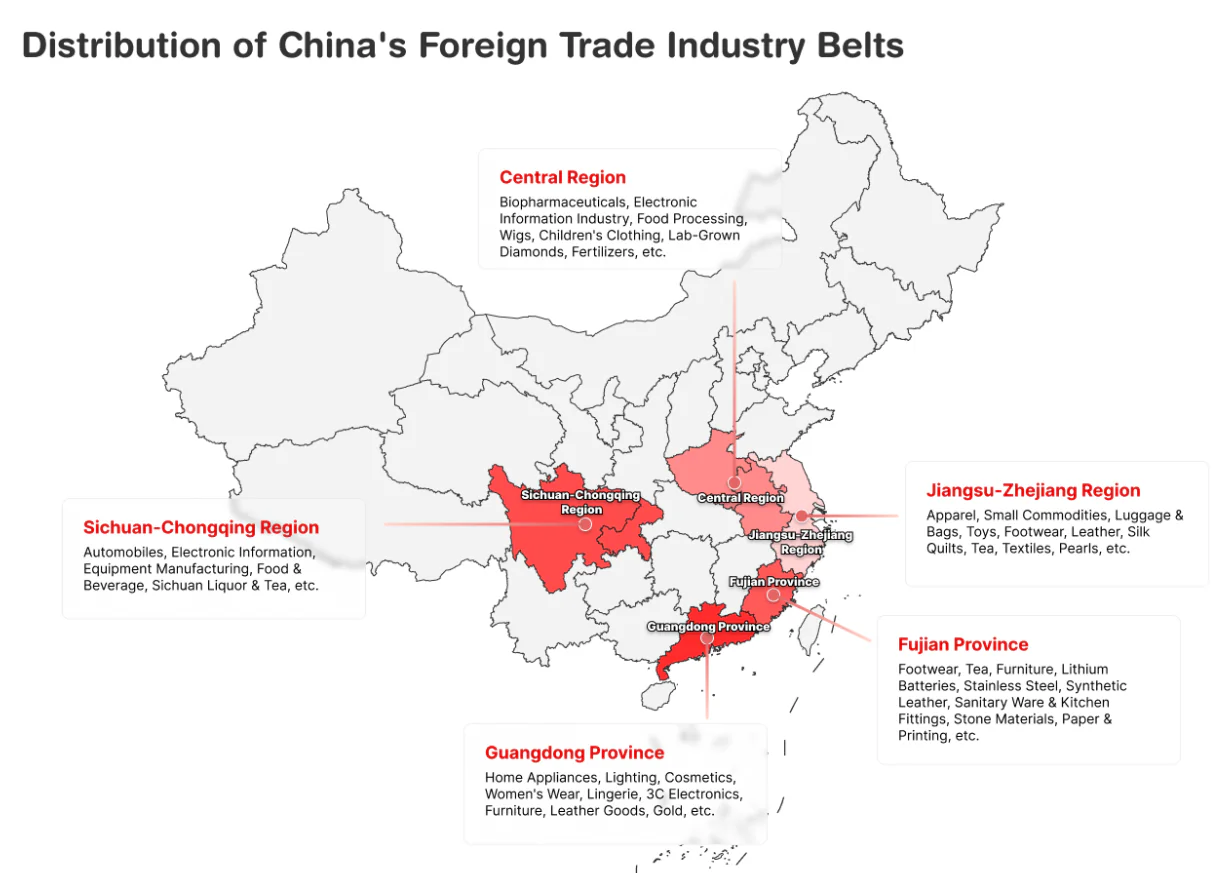
1. Guangdong Industrial Belt (Pearl River Delta Cluster)
Guangdong is China’s largest manufacturing province and a global export center, with highly developed industrial clusters across multiple cities.
Guangzhou: The Global Trading & Wholesale Hub
Guangzhou is one of the world’s most important wholesale and distribution centers for consumer goods.
Key Industries
- Apparel (Panyu, Haizhu, Huadu)
- Luggage & leather goods (Huadu – Shiling Town)
- Cosmetics & personal care (Baiyun)
- Jewelry & precious metals (Panyu)
- Furniture manufacturing (Daliang, Houjie)
- Lighting & audio equipment (Panyu)
Industrial Strengths
- Over 600,000 textile and apparel-related businesses
- China’s largest and most complete clothing wholesale market network
- Shiling (Huadu): 8,800+ leather goods manufacturers
- Baiyun cosmetics: over 1,800 licensed manufacturers, accounting for ~33% of China’s total production
Shenzhen: Global Electronics & Innovation Center
Shenzhen is one of the most advanced technology manufacturing hubs in the world.
Key Industries
- Consumer electronics (Huaqiangbei)
- Gold & jewelry (Shuibei)
- Smart devices, watches, eyewear
- Medical devices
Industrial Strengths
- Huaqiangbei: one of the largest electronics marketplaces globally
- Shuibei: RMB 100+ billion annual gold trading volume
- Eyewear manufacturing: global OEM base for luxury brands, with exports exceeding 80%
Dongguan: The World’s OEM Manufacturing Base
Dongguan is a critical node in global manufacturing supply chains.
Key Industries
- Apparel (Humen, Dalang)
- Toys (global production hub)
- Furniture (Daliang, Houjie)
- Paper & packaging
Industrial Strengths
- Over 4,000 toy manufacturers
- Strong OEM + ODM ecosystem evolving into original brand development
- Mature supply chain covering design → production → export
Foshan: Global Leader in Home Appliances & Ceramics
Foshan is one of the most important industrial clusters in China.
Key Industries
- Home appliances (Shunde)
- Furniture (Lecong)
- Ceramics (Shiwanzhen)
- Building materials & lighting
Industrial Strengths
- Known as the “Home Appliance Capital of China”
- Lecong: over 30,000 furniture-related enterprises
- Foshan ceramics: world’s largest production and export base
- Global supply influence in tiles and sanitary products
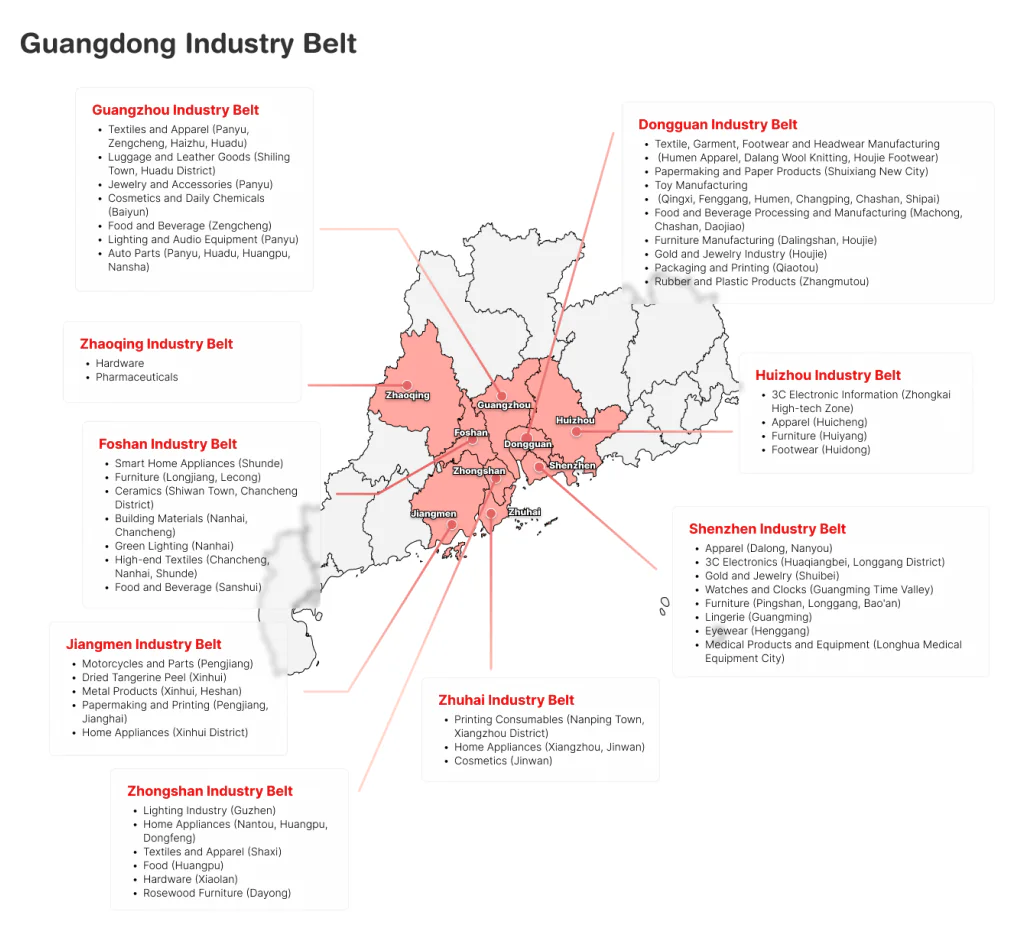
2. Zhejiang Industrial Belt (Export & E-commerce Powerhouse)
Zhejiang is a leader in cross-border e-commerce and export manufacturing, with strong global reach.
Yiwu (Jinhua): The World’s Small Commodity Capital
- Exports to 200+ countries
- Covers nearly all categories of small commodities
- A critical sourcing hub for Amazon, retail chains, and wholesalers
Wenzhou: Footwear & Light Industry Hub
- Footwear industry: ~RMB 87 billion
- Strong clusters in pumps, valves, and electrical equipment
Hangzhou & Ningbo: E-commerce & Advanced Manufacturing
- Home to Alibaba ecosystem
- Strong in smart manufacturing and digital trade infrastructure
3. Jiangsu Industrial Belt (High-End Manufacturing Cluster)
Jiangsu is one of China’s most advanced industrial provinces, known for high-tech and export-oriented industries.
Suzhou
- Electronics, precision manufacturing, textiles
- Global brands: Ecovacs, Dreame, etc.
Nantong
- Largest home textile production base in China
- Annual output exceeds 1.2 billion pieces
Wuxi & Changzhou
- Electric vehicles and advanced manufacturing
- Strong export-oriented industrial base
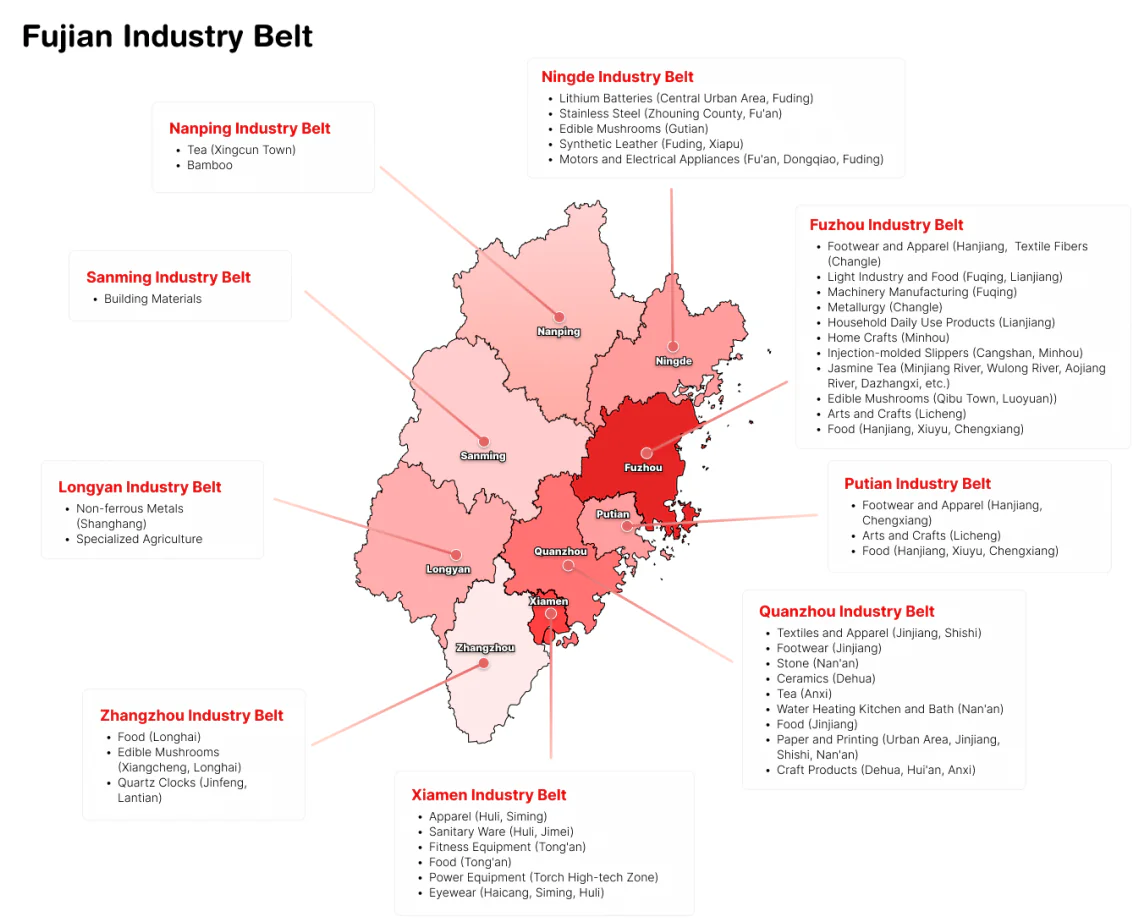
4. Fujian Industrial Belt (Maritime Trade Gateway)
Fujian plays a key role in China’s export trade due to its coastal location and port infrastructure.
Quanzhou
- Textile & footwear industry: RMB 200+ billion
- Accounts for:
- 40% of China’s sports shoes
- 20% of global sports footwear
Xiamen
- Global production base for sanitary ware
- Strong in electronics and eyewear manufacturing
Ningde
- Global leader in lithium battery manufacturing
- Annual output exceeds RMB 270 billion
5. Other Key Industrial Regions in China
Shanghai
- Integrated circuits (ICs)
- Automotive
- Biotech and cosmetics
Beijing
- Medical devices
- High-end electronics
Chongqing
- Motorcycle production hub
- Automotive components
Tianjin
- Bicycle manufacturing (largest export base)
- Electronics and automotive parts
Shandong
- Global leader in wigs (high-end human hair wigs)
- Home appliances and marine products
Henan
- Electronics manufacturing hub
- Food processing powerhouse (frozen food exports dominate China)
Why China’s Industrial Belts Are Critical for Global Buyers
China’s industrial clusters offer a unique competitive advantage in global sourcing:
1. Fully Integrated Supply Chain
Raw materials, components, manufacturing, and assembly are all concentrated within close proximity.
2. Cost Efficiency
Scale production + supplier density significantly reduce:
- Raw material costs
- Labor costs
- Logistics expenses
3. Speed & Flexibility
Rapid product development and customization capabilities.
4. Strong Export Infrastructure
Well-established logistics networks, ports, and trade systems support global shipping.
5. Innovation Through Clustering
Close cooperation among suppliers drives continuous product upgrades and innovation.
Conclusion
China’s industrial belts represent the foundation of global manufacturing and trade.
For international buyers, understanding these clusters is essential to:
- Identify the right suppliers
- Reduce sourcing risks
- Improve product competitiveness
- Scale efficiently in global markets
In the era of digital trade and AI-powered sourcing, China’s industrial clusters continue to play a central role in shaping the future of global supply chains.

Ivy is a Sourcing Specialist at Sellers Union. She shares hands-on experience in supplier selection, quality control, and market trends to help global wholesalers make informed decisions. Her goal is to simplify the sourcing process and help brands build efficient supply chains in the industry.









 L****
L**** R***
R*** G****
G**** Y*******
 T*****
 Y******
 Y******
 N*******
 O*******
 G*****
 W******