












Conocer la rentabilidad es fundamental para dirigir un negocio exitoso, ya sea que vendas productos online, administres una tienda minorista o trabajes en la distribución al por mayor. Esta guía completa te mostrará todo lo que necesitas saber sobre las rentabilidades, desde cálculos básicos hasta estrategias prácticas para su mejora.
¿Qué es la Margen de Beneficio?
La margen de beneficio es una métrica financiera que mide la cantidad de beneficio que una empresa obtiene por cada dólar de ingresos. Se expresa como porcentaje e indica la eficiencia con la que una empresa convierte las ventas en beneficios reales.
Piensen en esto de esta manera: si venden un producto por $100 y su margen de beneficio es del 20%, conservan $20 como beneficio después de cubrir todos los costos. El resto de $80 se destina a gastos como la compra de inventario, el envío, el marketing y los costos operativos.
Por ejemplo, un vendedor mayorista compra fundas para teléfonos de una Fabricante chino En $5 por unidad y los venden a los minoristas por $10 cada uno. Si sus gastos de operación son mínimos, podrían obtener una ganancia del 40-50% en cada transacción.
Conocer la fórmula de la Margen de Beneficio
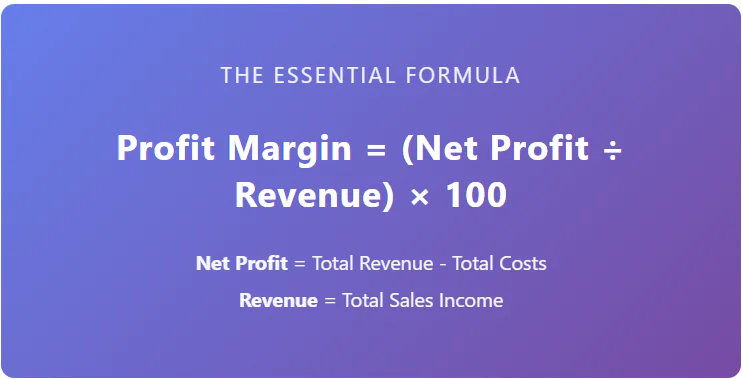
La fórmula básica de la ganancia bruta es sencilla:
Margen de ganancia = (Ganancia neta / Ingresos) × 100
Dónde:
- Resultado neto = Ingresos totales – Costos totales
- Ingresos = Ingresos totales por ventas
Vamos a simplificar esto con un ejemplo práctico. Supongamos que usted dirige una tienda online que vendió productos por un valor de $50.000 el mes pasado. Su coste total (inventario, envío, publicidad, tarifas de plataforma) fue de $35.000. Aquí está cómo calcular su margen de beneficio:
- Resultado neto = $50.000 – $35.000 = $15.000
- Margen de ganancia = ($15.000 / $50.000) × 100 = 30%
Este margen de beneficio del 30% significa que por cada dólar que ganas, conservas 30 centavos como beneficio.
Cómo calcular el margen de ganancia: guía paso a paso
Calcular la margen de beneficio no tiene que ser complicado. Siga estos pasos para determinar la rentabilidad de su negocio:
Paso 1: Determine su ingreso total
Sumar todos los ingresos por ventas del periodo que se está analizando. Esto incluye todo el dinero recibido de los clientes antes de realizar cualquier deducción.
Ejemplo: Un distribuidor mayorista vendió 1.000 unidades por $25 cada, generando $25.000 en ingresos.
Paso 2: Calcula tus costos totales
Resuma todos los gastos relacionados con las operaciones de su empresa:
- Gastos de venta de bienes (COGS): Lo que pagaste por los inventarios
- Gastos de operación: alquiler, servicios públicos, salarios
- Gastos de marketing y publicidad
- Gastos de envío y logística
- Comisiones por plataforma o transacción
Ejemplo: Los costos del distribuidor incluyen $12.000 por inventario de su proveedor, $3.000 en envío, $2.000 en marketing y $1.000 en otros gastos operacionales, lo que suma un total de $18.000.
Paso 3: Encuentre su ganancia neta
Suma los costos totales a los ingresos totales.
Ejemplo: $25.000 (ingresos) – $18.000 (costos) = $7.000 beneficio neto
Paso 4: Aplique la fórmula de margen de beneficio
Divida el beneficio neto por los ingresos y multiplíquelo por 100.
Ejemplo: ($7.000 / $25.000) × 100 = 28% margen de beneficio
Calcular la facturación total
Sumar todos los ingresos por ventas del período
Añade los costos totales
Incluya los costos de fabricación (COGS), envío, marketing y operaciones
Encuentra el beneficio neto
Suma los costos totales a los ingresos
Aplicar la fórmula
Divida el beneficio neto por los ingresos, multiplíquelo por 100
Calculador de margen de beneficio: hacer la matemática sencilla
Si bien los cálculos manuales funcionan perfectamente bien, utilizar una calculadora de margen de beneficio puede ahorrar tiempo y reducir los errores, especialmente al analizar múltiples productos o períodos de tiempo.
Una calculadora de margen de beneficio normalmente requiere tres entradas:
- Precio de venta o ingresos totales
- Precio de coste o costes totales
- El periodo de cálculo (opcional)
Hay muchas calculadoras gratuitas en línea, pero también puedes crear una plantilla simple de hoja de cálculo. Aquí tienes cómo se ve un diseño básico de una calculadora:
| Entrada | Valor |
|---|---|
| Ingresos | $10,000 |
| Costos totales | $6,500 |
| Resultado neto | $3,500 |
| Margen de beneficio | 35% |
Para Empresas mayoristas Al trabajar con múltiples líneas de productos, mantener una hoja de cálculo ayuda a determinar qué artículos ofrecen los mejores márgenes. Por ejemplo, un mayorista que importa desde China puede descubrir que los accesorios electrónicos ofrecen un margen del 35%, mientras que los artículos para el hogar solo ofrecen un margen del 18%, lo que le permite ajustar su estrategia de compra en consecuencia.
¿Qué es la Margen Bruta de Beneficio?
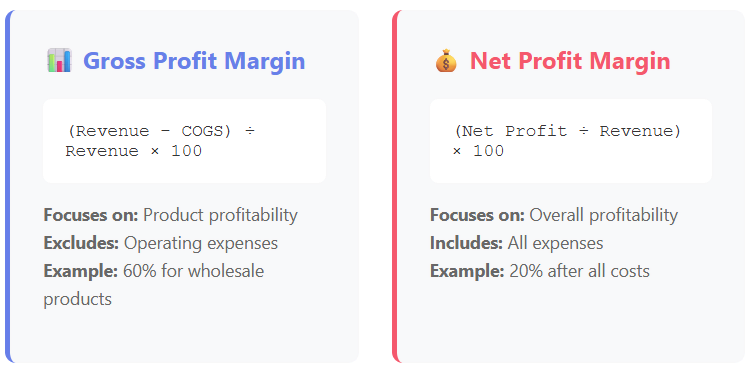
La margen bruta de beneficios se centra específicamente en la relación entre los ingresos y el coste de los bienes vendidos (COGS), excluyendo los gastos de explotación. Te indica cuánto dinero ganas con los productos antes de tener en cuenta los gastos generales de la empresa.
Forma de cálculo de la Margen de Beneficio Neto:
Margen de ganancia bruta = [(Ingresos – Costos de producción) / Ingresos] × 100
Esta métrica resulta particularmente útil para las empresas de venta al por mayor y los minoristas, ya que distinge la rentabilidad de los productos de la eficiencia operativa.
Ejemplo: Un mayorista compra productos de fabricantes chinos por $8 unidades y los vende por $20 unidades cada una.
- Ingresos por unidad: $20
- Gastos unitarios de fabricación: $8
- Beneficio bruto por unidad: $20 – $8 = $12
- Margen de ganancia bruta: ($12 / $20) × 100 = 60%
Este margen bruto del 60% significa que el mayorista tiene un margen considerable para cubrir gastos operativos como el almacenamiento, la comercialización y la administración, manteniendo al mismo tiempo una saludable margen de beneficio neto.
¿Qué es la Razón de Beneficio Neto?
La margen de ganancia neta es la métrica de rentabilidad más completa porque tiene en cuenta todos los gastos, y no solo el coste de los bienes vendidos. Representa la verdadera cifra final de tu empresa: lo que realmente ganas después de pagar todos los gastos.
Forma de cálculo de la ganancia neta:
Margen de ganancia neta = (Ganancia neta / Ingresos) × 100
Cuando el beneficio neto = Ingresos – Todos los gastos (COGS + Costos operativos + Impuestos + Intereses)
La diferencia entre la ganancia bruta y la ganancia neta puede ser significativa. Continuemos con nuestro ejemplo de venta al por mayor:
Escenario: El mayorista con una ganancia bruta del 60% tiene los siguientes costos adicionales:
- Ingresos: $100,000
- COGS: $40.000 (Beneficio bruto: $60.000)
- Gastos de operación: $35,000
- Impuestos y cargos: $5.000
- Resultado neto: $60.000 – $35.000 – $5.000 = $20.000
Margen de ganancia neta: ($20,000 / $100,000) × 100 = 20%
Observa cómo la tasa de margen bruto era del 60%, pero la tasa de margen neto es solo del 20%. Este margen ilustra por qué controlar los gastos operativos es tan crucial como garantizar buenos precios al por mayor.
Cómo calcular la ganancia neta
Para calcular la margen neta de beneficios se requiere una visión completa de su negocio. Finanzas empresariales. Aquí está el proceso detallado:
Paso 1: Calcular la ganancia neta
Start by subtracting COGS from revenue. If you sold $80,000 worth of products and paid $35,000 to suppliers, your gross profit is $45,000.
Step 2: Subtract Operating Expenses
Deduct all business operating costs:
- Employee salaries: $15,000
- Rent and utilities: $5,000
- Marketing: $8,000
- Software and tools: $2,000
- Shipping and fulfillment: $7,000
Total operating expenses: $37,000
Step 3: Calculate Net Profit
Gross Profit ($45,000) – Operating Expenses ($37,000) = Net Profit ($8,000)
Step 4: Determine Net Profit Margin
($8,000 / $80,000) × 100 = 10% net profit margin
For wholesale businesses, especially those sourcing from international markets like China, understanding net profit margin helps evaluate whether your supplier relationships and operational setup are sustainable long-term.
¿Qué es el margen de beneficio y cómo calcularlo? (Con ejemplos)
What is a Good Profit Margin?
This is one of the most common questions business owners ask, and the answer depends heavily on your industry, business model, and operational scale.
Industry Benchmarks
Different sectors have vastly different margin expectations:
- Grocery stores and supermarkets: 1-3% net profit margin
- Retail clothing: 4-13% net profit margin
- Electronics retail: 2-5% net profit margin
- Wholesale distributors: 5-10% net profit margin
- Software and digital products: 15-25% net profit margin
- Specialty retail: 7-15% net profit margin
For wholesale operations, particularly those importing from Chinese manufacturers, a good profit margin typically ranges from 15-30% on gross margin and 5-15% on net margin. However, these numbers vary based on:
- Product category: Electronics often have thinner margins (15-25%) compared to fashion accessories (40-60%)
- Order volume: Larger orders from suppliers often yield better unit costs
- Market positioning: Premium positioning allows higher margins
- Competition level: Highly competitive niches may compress margins
What Makes a “Good” Margin for Your Business?
Rather than fixating on industry averages, consider these factors:
- Sustainability: Can you maintain operations and grow with this margin?
- Competitive pricing: Does your margin allow competitive pricing while covering costs?
- Reinvestment capacity: Can you reinvest in inventory, marketing, and growth?
A wholesale business with 25% gross margins might struggle if operating expenses consume 20%, leaving only 5% net. Meanwhile, another business with 40% gross margins and well-controlled expenses achieving 15% net is in a much stronger position for growth.
Profit Margin vs. Wholesale Margin: Understanding the Difference
While often used interchangeably, profit margin and wholesale margin have distinct meanings in business operations.
Wholesale margin specifically refers to the markup between what a wholesaler pays a manufacturer and what they charge to retailers. It’s calculated as:
Wholesale Margin = [(Wholesale Price – Supplier Cost) / Wholesale Price] × 100
Ejemplo: A wholesaler buys smartphone accessories from a Chinese factory at $3 per unit and sells to retailers at $7 per unit.
Wholesale Margin = [($7 – $3) / $7] × 100 = 57%
However, this wholesale margin doesn’t account for the additional operating costs the wholesaler incurs—warehousing, shipping to customers, sales commissions, and administrative overhead. After these expenses, the actual profit margin might be considerably lower.
Margen de ganancia encompasses all costs and represents the actual profitability after every expense is paid.
For businesses involved in wholesale, especially those sourcing internationally, understanding both metrics is crucial. A healthy wholesale margin provides the buffer needed to cover operational expenses while maintaining competitive pricing and achieving a satisfactory profit margin.
How to Improve Your Profit Margin
Increasing profit margin is often more impactful than increasing sales volume. Here are proven strategies:
1. Negotiate Better Supplier Terms
For wholesale businesses, supplier costs typically represent the largest expense. Small improvements here compound significantly.
Strategy: If you’re sourcing from China, building strong relationships with manufacturers can lead to better pricing, especially as your order volumes increase. Consider:
- Ordering larger quantities for volume discounts
- Negotiating payment terms
- Consolidating suppliers to increase order sizes with fewer vendors
Ejemplo: Reducing your product cost from $10 to $9 while maintaining a $25 selling price increases gross profit margin from 60% to 64%—a significant improvement.
2. Optimize Your Product Mix
Not all products deliver equal margins. Analyze your inventory to identify high-margin items and promote them more aggressively.
Aplicación: A wholesaler might discover that while electronic gadgets sell quickly at 20% margins, lifestyle accessories move slower but deliver 45% margins. Strategic marketing toward higher-margin items can boost overall profitability without increasing sales volume.
3. Reduce Operating Expenses
Scrutinize every operational cost:
- Negotiate better shipping rates with logistics providers
- Automate repetitive tasks to reduce labor costs
- Optimize warehouse space utilization
- Review subscription services and eliminate unused tools
4. Implement Strategic Pricing
Sometimes your prices are simply too low. If you’re providing excellent value, customers will often accept modest price increases.
Consejo: Test price increases on a subset of products. A 5-10% price increase with only minimal customer pushback directly boosts profit margin.
5. Bundle Products
Create product bundles that combine high-margin items with popular products. This increases average order value while maintaining healthy margins.
Common Profit Margin Mistakes to Avoid
Understanding what not to do is as important as knowing best practices:
Mistake 1: Ignoring Hidden Costs
Many businesses calculate profit margin based only on obvious costs, forgetting:
- Payment processing fees (2-3% of sales)
- Returns and refunds
- Damaged inventory
- Platform commissions (Amazon, eBay fees)
Reality check: That “30% profit margin” might actually be 22% once all costs are included.
Mistake 2: Racing to the Bottom on Price
Competing solely on price is unsustainable for most businesses. It erodes profit margins and attracts price-sensitive customers who lack loyalty.
Better approach: Differentiate through service, quality, or expertise rather than being the cheapest option.
Mistake 3: Overlooking Small Expenses
Small recurring costs accumulate quickly. A $50 monthly subscription seems insignificant, but that’s $600 annually—which might represent 2-3% of a small business’s net profit.
Mistake 4: Not Tracking Margins by Product
Calculating only overall profit margin masks problems. Some products might lose money while others carry the business.
Solución: Maintain individual product margin analysis, especially in wholesale where different suppliers and product categories perform differently.
Profit Margin for Wholesale Businesses
Wholesale operations have unique margin considerations. Unlike retail businesses that sell directly to consumers, wholesalers operate on thinner margins with higher volumes.
Typical Wholesale Margin Structure
A standard wholesale distribution model might look like this:
- Manufacturer cost: $10 per unit
- Wholesale price to retailer: $20 per unit (100% markup, 50% margin)
- Suggested retail price: $40 per unit
The wholesaler’s 50% gross margin seems healthy, but after accounting for:
- Warehouse costs
- Shipping to retailers
- Sales team salaries
- Credit terms (net 30-60 days)
- Inventory carrying costs
The net profit margin might settle around 10-15%.
Sourcing from China: Margin Opportunities
Many wholesale businesses source products from Chinese manufacturers to maximize margins. This strategy offers several advantages:
Cost advantages: Chinese manufacturing often provides 40-60% lower costs compared to domestic alternatives, creating room for healthy margins while remaining price-competitive.
Example scenario: A wholesaler sources outdoor equipment accessories:
- Chinese manufacturer cost: $4.50 per unit
- Domestic manufacturer cost: $9.00 per unit
- Wholesale selling price: $15 per unit
With Chinese sourcing: Gross margin = ($15 – $4.50) / $15 = 70% With domestic sourcing: Gross margin = ($15 – $9.00) / $15 = 40%
This 30-point margin difference provides significant flexibility for competitive pricing, marketing investment, or enhanced profitability.
Challenges in International Wholesale
While international sourcing offers margin advantages, consider these factors:
- Longer lead times: Requires larger inventory investments
- Control de calidad: Ensuring consistent product quality requires strong supplier relationships
- Shipping costs: International freight affects margins, especially for heavy or bulky items
- Minimum order quantities: Often higher with international suppliers
Successful wholesale businesses balance these challenges against the margin benefits, often finding that despite complications, the cost savings justify the operational complexity.
FAQ About Profit Margin
¿Cómo se diferencia la margen de beneficio de la marca de precio?
Profit margin and markup are related but distinct concepts that are frequently confused. Markup is the percentage added to the cost price to determine the selling price. Margen de ganancia is the percentage of the selling price that represents profit.
Ejemplo: You purchase a product for $60 and sell it for $100.
- Markup: ($100 – $60) / $60 × 100 = 67%
- Profit Margin: ($100 – $60) / $100 × 100 = 40%
Notice that markup (67%) is higher than profit margin (40%) for the same transaction. When planning pricing strategies, it’s crucial to know which metric you’re using to avoid underpricing products.
¿Puede ser negativa la ganancia neta?
Yes, profit margin can be negative, which occurs when total costs exceed revenue. This situation means you’re losing money on each sale.
Ejemplo: A business has $50,000 in revenue but $65,000 in total costs.
- Net Profit: $50,000 – $65,000 = -$15,000
- Profit Margin: (-$15,000 / $50,000) × 100 = -30%
This negative profit margin indicates the business is unsustainable in its current form and requires immediate action—either reducing costs, increasing prices, or improving operational efficiency.
New wholesale businesses sometimes experience temporary negative margins during growth phases when they’re investing heavily in customer acquisition and infrastructure, but this should be a deliberate, short-term strategy with a clear path to profitability.
What’s the difference between profit margin and profit?
Profit is an absolute dollar amount, while profit margin is a percentage that shows profitability relative to sales.
Ejemplo:
- Company A: $1 million revenue, $100,000 profit = 10% profit margin
- Company B: $100,000 revenue, $30,000 profit = 30% profit margin
Company A makes more absolute profit ($100,000 vs. $30,000), but Company B is more efficient with a 30% profit margin compared to Company A’s 10%. Both metrics matter—profit for cash flow and business growth, profit margin for efficiency and sustainability.
¿Con qué frecuencia debo calcular la margen de beneficio?
For most businesses, calculating profit margin monthly provides a good balance between staying informed and not becoming overwhelmed with analysis. However, the ideal frequency depends on your business model:
- Monthly: Standard for most retail and wholesale businesses
- Quarterly: Suitable for businesses with longer sales cycles
- Weekly or daily: Useful during peak seasons or when testing new pricing strategies
- Per-product: Ongoing analysis for businesses with diverse product lines
Wholesale businesses should also calculate profit margin whenever negotiating with new suppliers or reviewing existing supplier relationships, as small cost changes significantly impact margins.
¿Es buena una ganancia del 10%?
A 10% net profit margin is generally considered good and sustainable for most traditional businesses, though context matters significantly.
When 10% is excellent:
- Grocery stores (industry average: 1-3%)
- High-volume, competitive retail
- Wholesale distribution with significant scale
When 10% might be low:
- Software or digital products (typical margins: 15-25%)
- Specialty or niche products with less competition
- Service-based businesses with low overhead
For wholesale businesses, a 10% net profit margin represents a healthy, sustainable operation. It provides enough cushion to weather market fluctuations, invest in growth, and maintain competitiveness while building business value over time.
¿Qué reduce la margen de beneficio?
Multiple factors can erode profit margins, and successful businesses monitor these continuously:
1. Rising supplier costs: Raw material increases or supplier price hikes directly impact margins if not passed to customers.
2. Increased competition: New competitors often trigger price wars that compress margins across the industry.
3. Operational inefficiencies: Waste, theft, damaged goods, or poor inventory management all reduce profitability.
4. Marketing and customer acquisition costs: Rising advertising expenses or customer acquisition costs can significantly impact net profit margins.
5. Currency fluctuations: For wholesale businesses importing from China or other countries, unfavorable exchange rate movements can suddenly increase costs by 5-10%.
6. Shipping and logistics costs: Freight rate increases, especially for international shipments, directly reduce margins.
The key is monitoring these factors proactively and adjusting your business strategy before they seriously damage profitability.
¿Cómo pueden las pequeñas empresas mejorar la rentabilidad?
Small businesses actually have several advantages in improving profit margins compared to larger competitors:
1. Flexibility: Small businesses can quickly adjust pricing, change suppliers, or pivot product focus without bureaucratic delays.
2. Niche focus: Specializing in specific products or customer segments allows premium pricing and reduced competition.
3. Lower overhead: Smaller operations often have lower fixed costs, making it easier to maintain healthy margins even with modest sales volumes.
4. Direct relationships: Building personal relationships with suppliers, especially when sourcing internationally, can lead to better pricing and terms.
5. Lean operations: Small businesses can eliminate waste and unnecessary expenses more easily than large organizations.
Practical steps:
- Review and renegotiate all vendor contracts annually
- Focus marketing on highest-margin products
- Implement basic automation for repetitive tasks
- Consider direct sourcing from manufacturers rather than using middlemen
- Regularly increase prices on established products (many businesses never raise prices despite cost increases)
Conclusión
Understanding and managing profit margin is essential for business success. Whether you’re running a small online store, a wholesale distribution business, or managing international sourcing relationships, profit margin tells you whether your business model is sustainable and where opportunities for improvement exist.
Remember these key takeaways:
- Profit margin measures efficiency, not just success: Higher margins mean you’re keeping more of every dollar earned.
- Both gross and net profit margins matter: Gross margin shows product profitability, while net margin reveals true bottom-line performance.
- Industry context is crucial: A “good” profit margin varies dramatically across different business types.
- Continuous monitoring drives improvement: Regular margin analysis helps identify problems early and opportunities for enhancement.
- Small improvements compound significantly: Even a 2-3% margin improvement can substantially impact annual profitability.
For wholesale businesses, particularly those leveraging international sourcing from markets like China, profit margin management becomes even more critical. The margin advantages from lower supplier costs must be balanced against operational complexities, but when managed effectively, these businesses can achieve healthy, sustainable profitability in competitive markets.
Start by calculating your current profit margin using the formulas and steps outlined in this guide. Then identify one or two specific areas for improvement and take action. Over time, consistent attention to profit margin will transform your business’s financial health and long-term sustainability.

Ivy es especialista en abastecimiento en Sellers Union. Comparte su experiencia práctica en la selección de proveedores, el control de calidad y las tendencias del mercado para ayudar a los mayoristas globales a tomar decisiones informadas. Su objetivo es simplificar el proceso de abastecimiento y ayudar a las marcas a construir cadenas de suministro eficientes en la industria.










 U****
 Y***
 Z***
 B******
 N******
 G******
 E*******
 G*****
 L*******
 H****
 W****
 H*******